



What jobs will AI replace by 2030? This question is becoming increasingly important as artificial intelligence moves from experimental technology into everyday workplaces. AI tools are already helping companies automate customer support, analyze information, generate content, process documents, write software, manage schedules, and perform repetitive administrative tasks. As these systems become more capable, many workers are understandably wondering how their careers could change over the next few years.
Table Of Content
- Quick Answer
- Key Takeaways
- What Jobs Will AI Replace by 2030?
- Jobs With High Automation Exposure
- Why Some Jobs Will Change Rather Than Disappear
- Jobs Most Likely to Be Automated by AI
- Routine Content and Basic Digital Production
- Will AI Replace Jobs or Transform Them?
- Human Skills Will Still Matter
- AI Adoption Will Not Be Equal Everywhere
- What Jobs Are Safe From AI?
- Focus on AI-Resilient Skills
- How to Prepare for AI Job Changes Before 2030
- Step 1: Audit Your Current Tasks
- Step 2: Learn Industry-Specific AI Tools
- Step 3: Measure Your Productivity Gains
- Comparison Table: AI Automation Risk by Job Type
- Real-World Examples of AI Changing Careers
- Benefits, Risks, and Limitations of AI Automation
- Common Mistakes to Avoid When Preparing for AI
- Expert Insights: The Best Career Strategy for the AI Era
- Frequently Asked Questions
- Will AI eliminate most jobs by 2030?
- Which jobs face the highest AI automation risk?
- Can AI replace creative professionals?
- What skills should workers learn before 2030?
- Will programmers lose their jobs because of AI?
- Are skilled trades protected from AI?
- How can I make my career more AI-resistant?
- Final Verdict
The important thing to understand is that AI will not necessarily eliminate an entire profession simply because it can perform some of its tasks. In many cases, businesses will use AI to automate repetitive responsibilities while keeping people in roles that require judgment, communication, creativity, leadership, physical adaptability, or accountability.
By 2030, the biggest changes are likely to happen in occupations built around predictable and repetitive digital workflows. At the same time, new opportunities may emerge for professionals who know how to combine industry expertise with AI tools.
This guide explains which jobs face the greatest automation pressure, which careers may remain more resilient, how AI could change existing roles, and what workers can do now to prepare for the changing employment landscape.
Quick Answer
AI is most likely to automate jobs and tasks involving repetitive digital processes, predictable decisions, standardized communication, and routine information handling.
Examples include:
- Data entry
- Basic administrative processing
- Routine customer support
- Telemarketing
- Basic bookkeeping
- Transcription
- Routine translation
- Repetitive content production
- Standard document processing
- Some entry-level coding tasks
- Basic research and reporting
- Scheduling and coordination
However, automation does not automatically mean complete job elimination. A company may use AI to reduce the number of employees required for routine work while creating new responsibilities around quality control, customer relationships, strategy, and AI supervision.
The future is therefore more likely to involve job transformation and task automation than the disappearance of every occupation touched by AI.
Key Takeaways
- AI is more likely to automate tasks than eliminate entire professions.
- Repetitive and predictable digital work faces the highest automation pressure.
- Administrative, data-processing, customer-service, and routine content tasks are particularly exposed.
- Human judgment, creativity, leadership, empathy, and physical adaptability remain difficult to automate completely.
- AI literacy will become an increasingly useful professional skill.
- Workers should learn to use AI rather than simply compete against it.
- Domain expertise combined with AI skills can create a strong career advantage.
- There is no completely guaranteed AI-proof profession.
What Jobs Will AI Replace by 2030?
When people ask what jobs will AI replace, they often imagine a machine taking over an entire profession. In reality, employment changes usually happen at the task level. A single occupation may contain dozens of responsibilities, and AI may automate only some of them.
Consider an administrative employee. Their daily work could include responding to routine emails, arranging meetings, updating spreadsheets, preparing reports, organizing documents, answering internal questions, and coordinating with colleagues. AI can already assist with several of these activities. As AI becomes integrated into office software, the amount of manual work required could decrease considerably.
The employee, however, may still be needed to solve unusual problems, coordinate people, handle confidential matters, communicate with stakeholders, and make decisions when instructions are unclear.
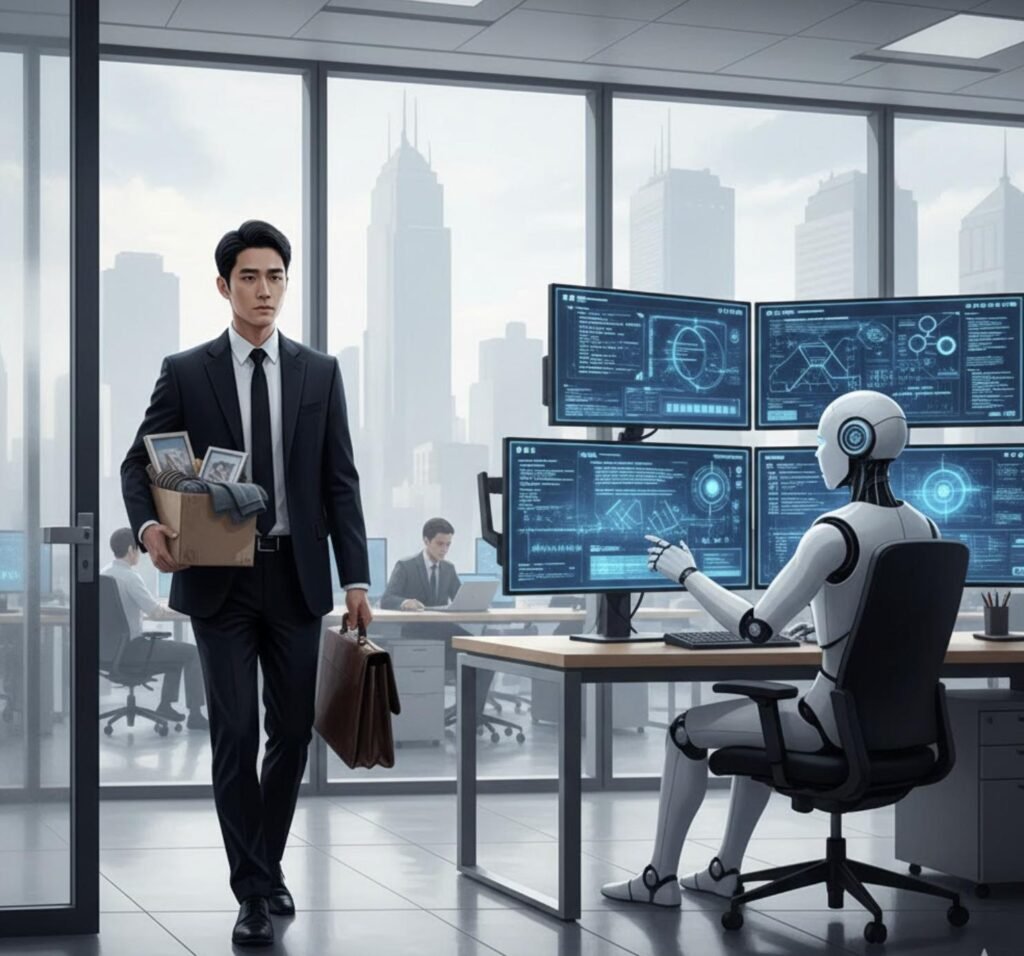
This distinction is essential when evaluating AI’s impact on employment.
Jobs With High Automation Exposure
Jobs with the highest exposure generally share several characteristics:
- The work is repetitive.
- Instructions are predictable.
- Inputs are primarily digital.
- Outputs follow a standard format.
- Decisions can be described using rules.
- Large amounts of historical data are available.
- Human interaction is limited.
Data entry is a straightforward example. A worker may manually extract information from invoices or forms and enter it into a database. AI-powered document-processing systems can increasingly perform extraction automatically, leaving humans to review exceptions.
Basic customer service follows a similar pattern. AI assistants can answer common questions, provide product information, check order statuses, and perform simple troubleshooting. Human agents can then focus on complicated complaints or unusual situations.
Telemarketing and scripted sales may also experience significant change because AI can conduct standardized conversations, qualify leads, send follow-ups, and schedule appointments.
Why Some Jobs Will Change Rather Than Disappear
A job can become substantially automated without disappearing completely.
For example, accountants may use AI for transaction categorization and reconciliation but continue providing financial analysis and professional advice. Developers may use AI to generate routine code while remaining responsible for architecture, security, testing, and business requirements.
This means workers should evaluate their individual tasks instead of assuming that an occupation is either “safe” or “unsafe.”
The more a person’s value comes from repetitive execution, the greater the automation risk. The more their value comes from judgment, relationships, accountability, or complex problem-solving, the more opportunities they may have to adapt.
Jobs Most Likely to Be Automated by AI
Several categories deserve particular attention because AI can already perform meaningful portions of their workflows.
Data entry is one of the clearest examples. Optical character recognition, document intelligence, and automated extraction systems can process large quantities of structured information much faster than humans. Companies that handle thousands of forms, invoices, applications, or records may therefore require fewer people for manual processing.
Transcription is another exposed area. Modern speech-recognition technology can convert audio into text quickly, while AI can also summarize meetings and organize important points. Human transcription professionals may increasingly focus on specialized, confidential, legal, or highly technical assignments where accuracy and contextual understanding are especially important.
Routine administrative work is similarly vulnerable. Scheduling, calendar management, meeting summaries, standard emails, document preparation, and repetitive reporting can all be assisted by AI.
Basic bookkeeping may also become more automated. Software can categorize transactions, identify unusual entries, reconcile records, and generate preliminary reports. Professional accountants are still required for interpretation, compliance, strategy, auditing, and complex financial decisions, but purely transactional work may require fewer people.
Customer service is another major area of transformation. AI can handle large volumes of standardized questions continuously. Businesses may use smaller human teams to manage escalations and complex interactions.
Routine Content and Basic Digital Production
AI-generated text, images, audio, and video are also changing digital production.
Simple product descriptions, social media variations, basic summaries, routine reports, and standardized marketing materials can often be produced faster with AI assistance.
That does not mean experienced writers, designers, or marketers will automatically become unnecessary. Instead, the value may move toward original research, strategy, editorial judgment, brand understanding, storytelling, and creative direction.
The same pattern is appearing in software development. AI coding systems can help developers write boilerplate code, explain functions, generate tests, and identify possible bugs. Junior developers may therefore face greater pressure to demonstrate skills beyond basic code production.
The important lesson is that routine production is more vulnerable than high-level professional judgment.
Will AI Replace Jobs or Transform Them?

A better question than “will ai replace jobs” is: Which tasks inside each occupation can AI perform, and what responsibilities remain distinctly human?
Imagine a marketing manager who previously spent several hours researching competitors, summarizing customer feedback, preparing reports, and creating first drafts. AI could potentially reduce the time required for these activities.
The manager can then spend more time developing strategy, understanding customers, coordinating campaigns, reviewing creative work, and making business decisions.
In this scenario, AI has not eliminated the role. It has increased the amount of output one professional can produce.
This concept of augmentation is likely to be extremely important through 2030.
Human Skills Will Still Matter
AI systems can process enormous amounts of information, but professional work often involves ambiguity.
A manager may have to decide which project deserves funding. A salesperson may need to understand an uncertain customer requirement. A consultant may need to persuade a skeptical client. A leader may have to resolve conflict between employees.
These situations involve context, responsibility, trust, and consequences.
Human skills such as:
- Critical thinking
- Negotiation
- Leadership
- Emotional intelligence
- Communication
- Strategic reasoning
- Relationship building
- Creative direction
can therefore become more important as routine tasks become automated.
AI Adoption Will Not Be Equal Everywhere
Another reason predictions about job replacement can be misleading is that businesses adopt technology at different speeds.
A large technology company may rapidly integrate AI into its workflows. A small business may continue using traditional processes for years.
Regulations, implementation costs, data quality, security concerns, employee training, and customer preferences all affect adoption.
A task may technically be automatable but still remain human-operated because automation is too expensive or unreliable.
For this reason, workers should avoid making career decisions based solely on sensational predictions about a specific year.
What Jobs Are Safe From AI?
There is no profession that can honestly be guaranteed to remain untouched by AI. Even highly resilient careers will probably use AI tools for research, documentation, scheduling, analysis, or other support activities.
However, when people ask what jobs are safe from AI, the better answer is to look at occupations that are more resistant to complete automation because they require physical adaptability, human trust, complex interpersonal interaction, or high-level judgment.
Skilled trades are a good example. Electricians, plumbers, HVAC technicians, mechanics, and construction professionals frequently work in environments that cannot be perfectly standardized. Every building, repair, and physical situation can present different challenges.
AI may help diagnose problems, estimate costs, schedule appointments, or provide technical guidance, but physically completing complicated work in unpredictable environments remains difficult to automate economically.

Healthcare and caregiving also contain many AI-resistant responsibilities. AI can support medical documentation, research, image analysis, scheduling, and monitoring. But nurses, caregivers, therapists, and other professionals also provide physical assistance, emotional support, communication, and human reassurance.
Leadership is another relatively resilient area. Organizations need people who can take responsibility for difficult decisions, manage teams, negotiate priorities, and build trust.
Focus on AI-Resilient Skills
Instead of searching endlessly for a supposedly “safe” job, workers should develop skills that complement AI.
These include:
- Industry expertise
- Critical thinking
- Communication
- Leadership
- Creativity
- Problem-solving
- Negotiation
- AI literacy
- Data interpretation
- Relationship management
A professional who understands both their industry and AI may have an advantage over someone who possesses only one of these skill sets.
The goal should not be to avoid automation completely. It should be to become valuable in the parts of work where automation creates opportunities for greater productivity.
How to Prepare for AI Job Changes Before 2030
Preparing for workplace automation does not necessarily require changing careers. A practical approach is to examine your existing responsibilities and gradually develop complementary skills.
Step 1: Audit Your Current Tasks
List everything you do during a typical workweek.
Separate those activities into three groups:
Highly repetitive: tasks that follow predictable rules.
AI-assisted: tasks where AI can speed up research, drafting, analysis, or organization.
Human-centered: activities requiring judgment, relationships, leadership, physical work, or accountability.
This exercise can reveal where your biggest career risks and opportunities are.
Step 2: Learn Industry-Specific AI Tools
Do not focus only on generic AI knowledge.
A marketer should understand AI marketing workflows. An accountant should explore accounting automation. A developer should understand AI-assisted development. A recruiter should learn how AI can support candidate research and communication.
Industry knowledge makes AI much more useful because you understand the context in which the technology is being applied.
Step 3: Measure Your Productivity Gains
Use AI to improve one repetitive task and measure the result.
For example:
- Reduce a four-hour research process to two hours.
- Automate recurring reports.
- Create faster first drafts.
- Reduce manual data processing.
- Improve customer response times.
Documenting measurable improvements can demonstrate that you are not merely familiar with AI—you know how to use it productively.
Comparison Table: AI Automation Risk by Job Type
| Job or Function | Automation Exposure | Main Reason |
|---|---|---|
| Data entry | Very High | Highly repetitive digital work |
| Basic transcription | Very High | Speech recognition can automate production |
| Routine administration | High | Predictable workflows |
| Scripted customer support | High | Standard questions can be automated |
| Telemarketing | High | Repeatable conversations |
| Basic bookkeeping | High | Transaction processing is structured |
| Routine content production | High | AI can generate standardized drafts |
| Basic translation | High | Machine translation is increasingly capable |
| Junior coding tasks | Medium-High | Routine code can be generated |
| Graphic production | Medium-High | Standardized assets can be generated |
| Accounting analysis | Medium | Human interpretation remains important |
| Software engineering | Medium | Architecture and complex decisions remain |
| Marketing strategy | Medium-Low | Requires context and judgment |
| Skilled trades | Low-Medium | Physical environments are unpredictable |
| Nursing and caregiving | Low-Medium | Human interaction and physical care |
| Leadership | Low | Trust and accountability are central |
| Complex negotiation | Low | Requires context and relationship skills |
These categories are not permanent. AI capabilities and business adoption will continue evolving.
Real-World Examples of AI Changing Careers
AI’s effect on employment can already be seen across multiple industries.
In customer service, AI assistants can answer common questions while human agents handle complex complaints. This changes the employee’s role from answering every request to managing difficult cases.
In software development, AI can generate code snippets, explain unfamiliar code, and create test cases. Developers can spend more time on architecture, security, debugging, and business requirements.
In marketing, AI can summarize customer feedback, create content variations, analyze information, and support campaign research. Marketers can then spend more time on positioning, strategy, brand development, and customer understanding.
In accounting, AI can assist with transaction categorization, reconciliation, and anomaly detection. Accountants can focus more on interpretation, compliance, financial planning, and advisory work.
These examples show a common pattern: AI tends to remove portions of workflows before it removes entire professions.
Benefits, Risks, and Limitations of AI Automation
AI automation can provide major benefits for both companies and workers. Businesses can process information faster, reduce repetitive workloads, operate around the clock, and improve productivity. Employees can spend more time on meaningful responsibilities instead of routine administrative work.
AI can also create new career opportunities in areas such as AI implementation, automation, data management, cybersecurity, AI governance, system integration, and AI-assisted professional services.
However, automation also presents serious risks.
Workers performing highly repetitive tasks may face reduced demand. Entry-level positions could become particularly important to watch because companies may automate responsibilities traditionally used to train new employees.
AI errors are another limitation. AI systems can produce incorrect or misleading information, making human review essential in high-stakes environments.
Privacy and security also matter. Employees should not place confidential company information, sensitive customer data, passwords, or proprietary material into AI systems without understanding the organization’s policies and the tool’s data practices.
Finally, access to AI training may be unequal. Workers who receive opportunities to learn new tools could advance faster than those who lack training or resources.
Common Mistakes to Avoid When Preparing for AI
One common mistake is assuming that every AI-exposed job will disappear. Automation exposure does not automatically mean total replacement.
Another mistake is looking only at job titles. Two people with the same job title may perform completely different tasks, and their automation risk can therefore be very different.
Workers should also avoid learning AI tools without strengthening their professional expertise. Knowing how to use a chatbot is useful, but understanding an industry allows you to determine whether AI output is accurate and valuable.
Another mistake is waiting until automation becomes unavoidable. Career preparation works better when it starts gradually.
Professionals can begin by identifying one repetitive task, learning an appropriate AI tool, testing it, reviewing the output, and measuring the result.
For people who want to follow broader AI developments and practical AI resources, makeainow can provide an additional source of AI-related information.
Expert Insights: The Best Career Strategy for the AI Era
The strongest response to AI disruption is not trying to predict every job that will disappear by 2030.
Instead, think in terms of tasks, skills, and adaptability.
Ask yourself:
- Which parts of my work are repetitive?
- Which responsibilities can AI already assist with?
- Which parts require human judgment?
- What skills are becoming more valuable?
- How can I use AI to increase my productivity?
- What evidence can I show that I can work effectively with AI?
The professionals most likely to remain competitive will not necessarily be those who know the most about artificial intelligence.
They may be people who combine deep domain knowledge with practical AI skills.
A financial professional who understands both financial analysis and AI automation can be more valuable than someone who understands only automation. A marketer who understands customers, branding, and AI workflows can outperform someone who simply knows how to generate AI content.
The future of work is therefore likely to reward combination skills.
Frequently Asked Questions
Will AI eliminate most jobs by 2030?
There is no reliable basis for saying that AI will eliminate most jobs by 2030. AI is more likely to automate specific tasks, change job responsibilities, and reduce demand for some highly repetitive roles.
Which jobs face the highest AI automation risk?
Data entry, routine administrative work, scripted customer support, telemarketing, basic transcription, transaction processing, and standardized digital production face relatively high automation exposure.
Can AI replace creative professionals?
AI can automate parts of creative production, including drafting, editing, image generation, and variations. However, strategy, originality, storytelling, creative direction, brand understanding, and human judgment remain important.
What skills should workers learn before 2030?
Workers should develop AI literacy alongside critical thinking, communication, industry expertise, problem-solving, creativity, leadership, and relationship-building.
Will programmers lose their jobs because of AI?
AI will automate some programming tasks, particularly repetitive coding and documentation. However, software engineering also requires architecture, security, testing, requirements analysis, and system-level decision-making.
Are skilled trades protected from AI?
Skilled trades may be comparatively resilient because workers often operate in unpredictable physical environments. AI can still support these professionals through diagnostics, scheduling, planning, and technical guidance.
How can I make my career more AI-resistant?
Identify repetitive tasks in your role, learn relevant AI tools, develop strong domain expertise, improve communication and critical-thinking skills, and learn how to verify and manage AI output responsibly.
Final Verdict
AI will almost certainly reshape the job market significantly before 2030, but the future is unlikely to be as simple as asking what jobs will AI replace by 2030 and assuming machines will replace humans across the board.
The occupations facing the greatest pressure are those built around repetitive, predictable, rules-based digital tasks. Data entry, routine administration, scripted customer support, basic transaction processing, transcription, and standardized content production are likely to experience substantial automation.
At the same time, careers requiring judgment, leadership, creativity, relationships, physical adaptability, and accountability may remain comparatively resilient.
The smartest career strategy is therefore not to search for a profession that AI can never touch. Instead, become the professional who knows how to work effectively with AI while offering capabilities that remain difficult to automate.
By 2030, AI skills may be less of a specialized advantage and more of a basic workplace expectation. The real competitive advantage will come from combining AI literacy with expertise, critical thinking, communication, and human judgment.
AI may change the way work is performed, but workers who adapt early can position themselves to benefit from that transformation rather than simply react to it.