



Is ChatGPT Generative AI? Understanding How ChatGPT Fits Into the Generative AI Revolution

If you’ve used ChatGPT to write emails, summarize documents, generate code, or answer questions, you may have wondered: is chatgpt generative ai? The short answer is yes. ChatGPT is one of the most widely used examples of generative artificial intelligence, a branch of AI that creates new content instead of simply analyzing existing information.
Table Of Content
- Quick Answer
- Key Takeaways
- What Is Generative AI?
- Large Language Models
- Transformer Architecture
- Deep Learning
- Is ChatGPT Generative AI? Understanding the Answer
- It Creates New Content
- It Understands Context
- It Learns From Patterns
- It Uses Natural Language Processing
- It Supports Numerous Applications
- Why Is ChatGPT Generative AI Instead of Traditional AI?
- How Does ChatGPT Work as a Generative AI Model?
- Training and Pre-Training
- Transformer Architecture
- Reinforcement Learning From Human Feedback
- Is ChatGPT Generative AI? ChatGPT vs Traditional AI
- Real-World Examples Showing Why ChatGPT Is Generative AI
- Content Creation
- Customer Support
- Education and Learning
- Software Development
- Business Productivity
- Benefits of ChatGPT Generative AI in Daily Life and Business
- Increased Productivity
- Improved Accessibility
- Enhanced Creativity
- Cost Savings
- Faster Learning
- Risks and Limitations of ChatGPT Generative AI
- Inaccurate Information
- Lack of True Understanding
- Bias in Outputs
- Privacy Concerns
- Dependence on AI
- Common Mistakes When Using ChatGPT Generative AI
- Assuming Everything Is Accurate
- Using Poor Prompts
- Ignoring Human Editing
- Expecting Human-Level Judgment
- Expert Insights on Why ChatGPT Is Generative AI
- The Future of ChatGPT Generative AI Technology
- Multimodal AI Experiences
- More Personalized Assistance
- Enterprise Adoption
- Improved Accuracy and Safety
- Human-AI Collaboration
- FAQs About Is ChatGPT Generative AI
- Is ChatGPT generative AI?
- What type of AI is ChatGPT?
- Who created ChatGPT?
- Is ChatGPT different from traditional AI?
- Does ChatGPT think like humans?
- Can ChatGPT generate code?
- Is ChatGPT machine learning or generative AI?
- Can ChatGPT replace human writers?
- What are examples of generative AI besides ChatGPT?
- Why is ChatGPT called generative AI?
- Final Verdict: Is ChatGPT Generative AI?
Generative AI has transformed how people interact with technology. From creating blog posts and images to writing software code and assisting with research, these systems are changing industries and everyday workflows. ChatGPT, developed by OpenAI, is among the most recognized applications of this technology because it enables users to communicate naturally with AI through conversations.
Understanding where ChatGPT fits within the broader landscape of generative AI is important for individuals, businesses, educators, developers, and content creators. While many people use ChatGPT daily, there is still confusion about how it works, what makes it generative, and how it differs from traditional AI systems.
This guide explains the relationship between ChatGPT and generative AI, explores the underlying technology, and highlights practical applications, benefits, and limitations that every user should understand.
Quick Answer
Yes, ChatGPT is generative AI. It uses large language models (LLMs) trained on vast amounts of text data to generate human-like responses, answer questions, write content, summarize information, assist with coding, and perform many other language-based tasks. Unlike traditional AI systems that mainly classify or analyze information, ChatGPT creates new text based on user prompts.
Key Takeaways
- ChatGPT is a form of generative artificial intelligence.
- It is powered by large language models (LLMs).
- Generative AI creates original content rather than simply analyzing data.
- ChatGPT can produce text, code, summaries, explanations, and conversational responses.
- It differs from predictive and rule-based AI systems.
- Businesses, educators, and creators increasingly rely on ChatGPT for productivity and innovation.
- Human oversight remains essential because AI-generated responses can sometimes contain inaccuracies.
What Is Generative AI?
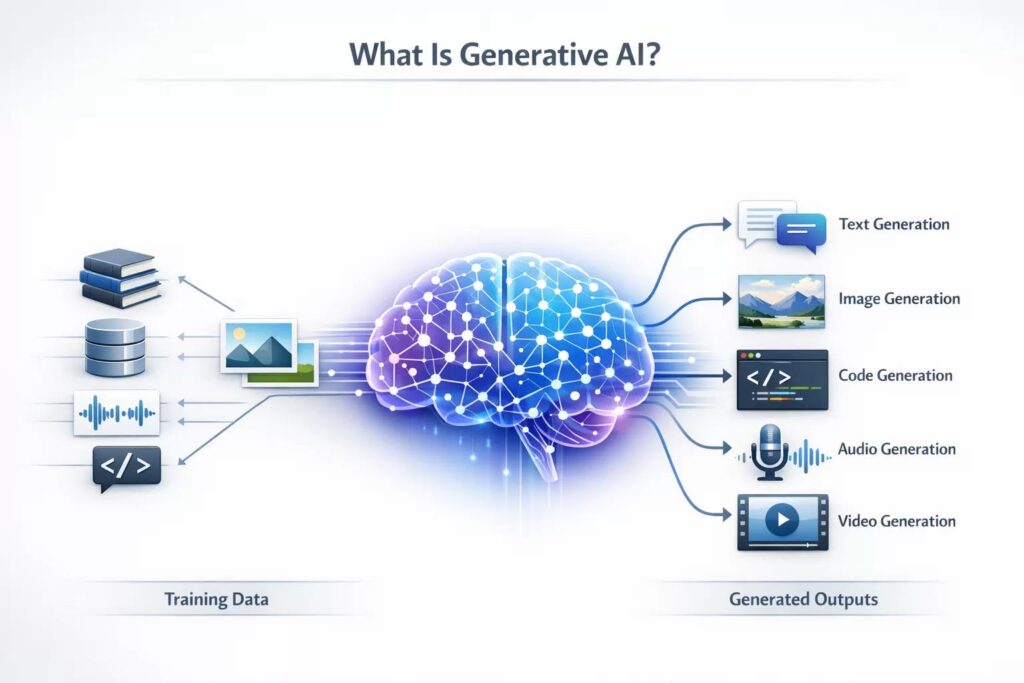
Generative AI refers to a category of artificial intelligence designed to create new content based on patterns learned from large datasets. Instead of only recognizing images or predicting outcomes, these systems generate text, images, audio, videos, software code, and other forms of content. If you’re new to artificial intelligence in general, it may also help to understand the broader concept of AI and how different types of AI systems work. Our guide on what is AI definition explains the fundamentals before diving deeper into generative models like ChatGPT.
Traditional AI applications focus on analysis and classification. For example, spam filters identify unwanted emails, recommendation engines suggest products, and fraud detection systems flag suspicious transactions. Generative AI goes beyond analysis by producing something entirely new in response to user input.
The technology behind generative AI relies heavily on machine learning and deep neural networks. Modern systems are trained on massive datasets that allow them to understand relationships between words, concepts, styles, and patterns. Once trained, these models can create outputs that closely resemble human-created content.
Generative AI appears across many tools and industries:
- AI chatbots and virtual assistants
- Text generation platforms
- Image generation tools
- Coding assistants
- Music creation applications
- Video generation systems
- Customer service automation platforms
Several technologies power generative AI systems, including:
Large Language Models
Large language models are neural networks trained on enormous collections of text. They learn grammar, context, reasoning patterns, and language structures that enable them to generate coherent responses.
Examples include GPT models, Claude, Gemini, and other transformer-based architectures.
Transformer Architecture
Transformers revolutionized natural language processing by enabling AI systems to understand context more effectively. Their attention mechanisms help models recognize relationships between words and sentences, resulting in more natural outputs.
Deep Learning
Deep learning techniques allow generative AI systems to discover complex patterns from data without relying solely on manually programmed rules. This flexibility makes modern AI applications far more capable than earlier systems.
Because of these technologies, generative AI is increasingly used for writing articles, creating designs, producing marketing materials, generating software code, and supporting research tasks.
Is ChatGPT Generative AI? Understanding the Answer
Yes, ChatGPT is generative AI because its primary purpose is to generate new content in response to user prompts. Rather than retrieving predefined answers from a database, ChatGPT predicts and produces sequences of words that form coherent responses.
ChatGPT is based on OpenAI’s Generative Pre-trained Transformer (GPT) architecture. The word “generative” itself reflects the model’s ability to create text dynamically. When users ask questions, request summaries, or seek explanations, ChatGPT generates original responses based on patterns learned during training.
Several characteristics make ChatGPT a generative AI system:
It Creates New Content
ChatGPT can generate:
- Articles
- Emails
- Product descriptions
- Social media posts
- Programming code
- Summaries
- Brainstorming ideas
- Conversational responses
Each response is created dynamically rather than copied from a fixed database.
It Understands Context
Modern GPT models can maintain conversational context across multiple exchanges. This allows ChatGPT to answer follow-up questions, revise content, and adapt to different tones and objectives.
It Learns From Patterns
ChatGPT does not memorize every answer. Instead, it learns relationships between words, phrases, and concepts during training. These learned patterns enable it to generate relevant outputs for a wide variety of tasks.
It Uses Natural Language Processing
Natural language processing enables ChatGPT to understand prompts and communicate in human-like language. Users can interact with the model conversationally without needing specialized commands.
It Supports Numerous Applications
Organizations and individuals use ChatGPT for:
- Customer support
- Education
- Research assistance
- Content creation
- Coding help
- Marketing
- Data analysis
- Productivity tasks
Because of its ability to generate original language-based outputs, ChatGPT clearly belongs to the category of generative AI rather than traditional rule-based artificial intelligence.
Why Is ChatGPT Generative AI Instead of Traditional AI?
Many people assume all AI systems are essentially the same, but different forms of AI serve different purposes. ChatGPT often gets grouped with older AI technologies, leading to misunderstandings about what it actually does.
Traditional AI systems usually perform specific tasks. For example:
- Recommendation engines suggest movies.
- Fraud detection tools identify suspicious transactions.
- Image recognition software classifies objects.
- Search algorithms rank information.
These systems analyze and predict, but they typically do not create entirely new content.
ChatGPT, however, generates responses using probability and contextual understanding. This ability makes it fundamentally different from conventional rule-based software.
Another source of confusion comes from search engines. People may assume ChatGPT works like Google by retrieving answers from the internet. In reality, ChatGPT generates responses using knowledge and patterns learned during training, although some versions may include web browsing capabilities.
Understanding this distinction helps users set realistic expectations and use AI tools more effectively. Generative AI systems excel at creating and assisting, whereas traditional AI often focuses on classification, detection, and optimization.
How Does ChatGPT Work as a Generative AI Model?
Many people know that ChatGPT can answer questions, write articles, summarize information, and even generate code, but fewer understand what happens behind the scenes. Knowing how ChatGPT works helps explain why it is considered one of the most powerful examples of generative AI.
At its core, ChatGPT is built on a large language model (LLM) based on the Generative Pre-trained Transformer (GPT) architecture developed by OpenAI. The model is trained on enormous amounts of text data, enabling it to recognize patterns, understand context, and generate human-like responses.
Unlike traditional software that follows fixed instructions, ChatGPT predicts the next most likely word or sequence of words based on the user’s prompt. Although this process sounds simple, billions of parameters and deep learning algorithms allow the model to produce highly sophisticated outputs.
Training and Pre-Training
Before users interact with ChatGPT, the model undergoes extensive training. During this phase, it learns grammar, facts, reasoning patterns, writing styles, and relationships between concepts from large datasets.
This training process enables the model to understand:
- Sentence structure
- Context and meaning
- Different tones and writing styles
- Common reasoning patterns
- Relationships between topics
Because the system is pre-trained, it can perform many tasks without requiring separate programming for each one.
Transformer Architecture
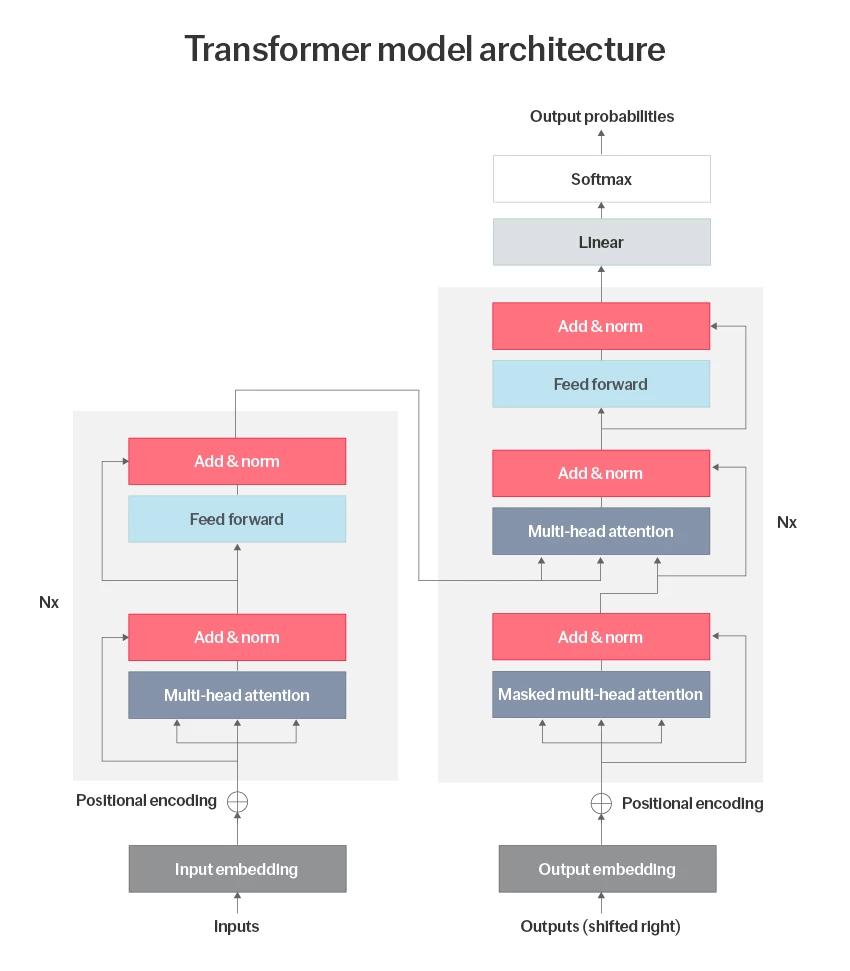
The transformer architecture revolutionized natural language processing. Instead of reading text sequentially like older systems, transformers use attention mechanisms to understand relationships between words and sentences.
This allows ChatGPT to:
- Maintain context across conversations.
- Understand follow-up questions.
- Produce coherent paragraphs.
- Generate natural-sounding responses.
- Adapt to different communication styles.
Transformers are considered one of the biggest breakthroughs in modern AI and form the foundation of many systems, including ChatGPT, Claude, Gemini, and other advanced language models. If you’re curious about the technologies behind intelligent systems, learning how to make an AI can provide deeper insights into the development of modern AI applications like ChatGPT.
Reinforcement Learning From Human Feedback
Another important aspect of ChatGPT’s development is reinforcement learning from human feedback (RLHF). Human trainers evaluate responses and help improve the quality, helpfulness, and safety of the model.
This process helps ChatGPT:
- Provide more accurate answers.
- Avoid harmful outputs.
- Produce natural conversations.
- Better understand user intent.
- Generate clearer explanations.
Because of these technologies, ChatGPT can perform a wide variety of tasks without being programmed specifically for each one. This flexibility is one reason why it is considered a landmark application of generative AI.
Is ChatGPT Generative AI? ChatGPT vs Traditional AI
Although ChatGPT is an AI system, it differs significantly from traditional artificial intelligence applications. Understanding these differences helps users appreciate what makes generative AI unique.
| Feature | ChatGPT (Generative AI) | Traditional AI |
|---|---|---|
| Main Function | Creates content | Analyzes or predicts |
| Output | Dynamic and original | Fixed or predefined |
| Interaction | Conversational | Task-specific |
| Learning Method | Deep learning and LLMs | Rules or machine learning |
| Applications | Writing, coding, summaries, brainstorming | Fraud detection, recommendations, classification |
| Flexibility | High | Limited |
| User Input | Natural language prompts | Structured commands |
| Creativity | Capable of generating content | Usually non-creative |
Traditional AI systems excel at pattern recognition and prediction. Generative AI systems like ChatGPT go further by creating entirely new outputs based on learned patterns.
Real-World Examples Showing Why ChatGPT Is Generative AI
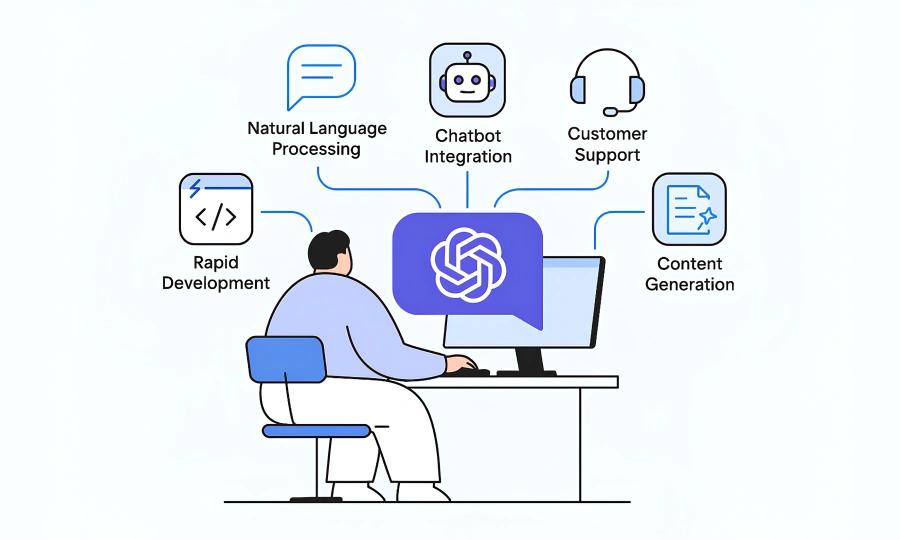
ChatGPT has become much more than a chatbot. Businesses, students, marketers, developers, and researchers use it daily to improve productivity and solve problems. You can also explore MakeAINow, an all-in-one AI platform that brings together AI writing, image generation, code generation, and chatbot tools in one place for creators and businesses.
Content Creation
Bloggers, writers, and marketers use ChatGPT to generate:
- Articles
- Product descriptions
- Email campaigns
- Social media posts
- SEO content
- Ad copy
Rather than replacing human creativity, ChatGPT often acts as a collaborative assistant that speeds up the writing process.
Customer Support
Companies use AI-powered chatbots to answer customer questions around the clock. ChatGPT can help businesses provide instant responses, reducing waiting times and improving customer experiences.
Examples include:
- E-commerce support
- Technical troubleshooting
- FAQ assistance
- Appointment scheduling
Education and Learning
Students and educators use ChatGPT for:
- Explaining complex concepts
- Language learning
- Research assistance
- Study guides
- Practice questions
Teachers also use AI tools to generate lesson plans and educational materials.
Software Development
Developers rely on ChatGPT to:
- Generate code snippets
- Debug programs
- Explain algorithms
- Learn new frameworks
- Create documentation
Coding assistants based on generative AI have become valuable productivity tools across the software industry.
Business Productivity
Professionals use ChatGPT for:
- Meeting summaries
- Brainstorming ideas
- Creating presentations
- Drafting reports
- Data analysis assistance
These practical applications demonstrate why generative AI is becoming increasingly important across industries. As AI tools become more accessible, individuals and businesses are discovering practical ways to integrate them into everyday tasks. If you’re just getting started, this guide on how do I use AI can help you understand the most effective ways to use AI in daily workflows.
Benefits of ChatGPT Generative AI in Daily Life and Business

ChatGPT offers numerous advantages for individuals and organizations. Its ability to automate repetitive tasks and enhance creativity makes it valuable across multiple sectors.
Increased Productivity
Tasks that previously required hours can often be completed in minutes. Users can quickly draft emails, create content, summarize documents, and brainstorm ideas.
This efficiency allows professionals to focus on higher-value activities.
Improved Accessibility
People without technical expertise can interact with ChatGPT using natural language. Users do not need programming skills to benefit from AI-powered assistance.
This accessibility has accelerated AI adoption worldwide.
Enhanced Creativity
Writers, marketers, and creators often use ChatGPT as a brainstorming partner. It can suggest ideas, provide alternative approaches, and help overcome creative blocks.
Instead of replacing creativity, generative AI often amplifies it.
Cost Savings
Businesses can automate repetitive processes, reducing operational costs. AI tools help organizations handle customer support, content generation, and internal documentation more efficiently.
Faster Learning
Students and professionals use ChatGPT to understand complex topics more quickly. AI-generated explanations can simplify difficult concepts and provide personalized assistance.
As generative AI continues evolving, these benefits are expected to expand further.
Risks and Limitations of ChatGPT Generative AI
Despite its impressive capabilities, ChatGPT has important limitations that users should understand. Treating AI outputs as infallible can lead to mistakes and misinformation.
Inaccurate Information
ChatGPT sometimes produces incorrect or misleading answers, often referred to as “hallucinations.” Because it generates responses probabilistically, accuracy is not guaranteed.
Users should verify important information through trusted sources.
Lack of True Understanding
Although ChatGPT appears intelligent, it does not think or understand concepts like humans. It predicts patterns rather than possessing consciousness or genuine reasoning.
This distinction is essential when interpreting AI-generated responses.
Bias in Outputs
Training data may contain biases that influence responses. Developers continually work to minimize these issues, but no AI model is entirely free from bias.
Human oversight remains necessary.
Privacy Concerns
Users should avoid sharing sensitive information with AI systems. Businesses should establish policies governing how AI tools are used internally.
Responsible AI usage includes protecting confidential data.
Dependence on AI
Excessive reliance on AI can reduce critical thinking and problem-solving skills. Human expertise and judgment are still essential, especially in healthcare, finance, legal services, and education.
Understanding these limitations allows users to benefit from ChatGPT while avoiding common pitfalls.
Common Mistakes When Using ChatGPT Generative AI
As generative AI becomes more popular, many users develop unrealistic expectations about what ChatGPT can do. Avoiding these mistakes can lead to better results.
Assuming Everything Is Accurate
One of the most common misconceptions is believing every answer is factually correct. AI-generated responses should always be reviewed and verified when accuracy matters.
Using Poor Prompts
Vague prompts often lead to vague outputs. Clear instructions, context, and objectives usually produce much better responses.
Instead of asking:
“Write something about AI.”
Try:
“Explain whether ChatGPT is generative AI for beginners and include practical examples.”
Specific prompts generate higher-quality answers.
Ignoring Human Editing
AI-generated content often benefits from human review. Editing improves clarity, originality, tone, and factual accuracy. Many creators also focus on making AI-generated content sound more natural and authentic. Learning how to get AI to write like a human can help improve readability, engagement, and overall content quality.
The best results usually come from collaboration between humans and AI.
Expecting Human-Level Judgment
ChatGPT cannot replace experts in medicine, law, or finance. Professional advice should always come from qualified specialists.
Generative AI is a tool for assistance, not a substitute for human expertise.
By understanding these mistakes, users can maximize the value of ChatGPT while using it responsibly.
Expert Insights on Why ChatGPT Is Generative AI
Artificial intelligence has evolved far beyond rule-based systems and narrow machine learning applications. Industry experts increasingly view generative AI as one of the most transformative technologies since the emergence of the internet and cloud computing. ChatGPT sits at the center of this shift because it brought advanced AI capabilities to mainstream users.
One reason experts consider ChatGPT a milestone in AI development is its accessibility. Previous AI systems often required technical knowledge or specialized software. ChatGPT introduced a conversational interface that allows anyone to interact with sophisticated language models using everyday language.
Another important insight is that generative AI should be viewed as an augmentation tool rather than a replacement for human intelligence. Professionals across industries use ChatGPT to improve productivity, automate repetitive tasks, and accelerate research, but human judgment remains essential.
Experts also emphasize that prompt engineering and human oversight are becoming increasingly valuable skills. The quality of AI-generated outputs depends heavily on the instructions provided. Organizations that combine AI capabilities with domain expertise are likely to achieve the greatest benefits.
Businesses are already integrating generative AI into customer service, content creation, software development, marketing, healthcare, education, and research workflows. This trend suggests that AI literacy will become an essential skill in the coming years.
Responsible AI usage is another recurring theme among experts. Transparency, privacy, ethical considerations, and verification of AI-generated information remain critical as adoption continues to grow. Rather than replacing people, ChatGPT and similar systems are expected to function as collaborative tools that enhance human capabilities.
The Future of ChatGPT Generative AI Technology
Generative AI technology is advancing rapidly, and ChatGPT represents only the beginning of a much broader transformation. Future developments are expected to make AI systems more capable, personalized, and integrated into everyday life.
Multimodal AI Experiences
Modern AI systems are increasingly capable of understanding and generating multiple forms of content, including:
- Text
- Images
- Audio
- Video
- Code
Future versions of generative AI will likely combine these capabilities seamlessly, allowing users to interact with AI across different media formats.
More Personalized Assistance
AI models are expected to become better at understanding user preferences, workflows, and objectives. This personalization could enable highly customized learning experiences, business support, and productivity enhancements.
For example, AI assistants may eventually adapt to individual writing styles, professional needs, and communication habits.
Enterprise Adoption
Businesses worldwide are investing heavily in generative AI. Companies are integrating AI into:
- Customer support systems
- Content marketing
- Internal knowledge bases
- Software development
- Data analysis
- Workflow automation
These implementations are likely to increase efficiency and create new opportunities for innovation.
Improved Accuracy and Safety
Researchers continue to focus on reducing hallucinations, improving factual reliability, and enhancing safety mechanisms. Future AI systems are expected to provide more trustworthy outputs and better reasoning capabilities.
Human-AI Collaboration
Rather than replacing human workers, generative AI is expected to become a collaborative partner. Professionals who understand how to work effectively with AI tools may gain significant productivity advantages.
As the technology evolves, the relationship between humans and AI will increasingly focus on cooperation rather than competition.
FAQs About Is ChatGPT Generative AI
Is ChatGPT generative AI?
Yes. ChatGPT is a generative AI system built on large language models. It generates original responses, summaries, articles, code, and conversations based on user prompts.
What type of AI is ChatGPT?
ChatGPT is a conversational AI application powered by generative artificial intelligence and transformer-based large language models.
Who created ChatGPT?
ChatGPT was developed by OpenAI. It is based on the GPT (Generative Pre-trained Transformer) family of language models.
Is ChatGPT different from traditional AI?
Yes. Traditional AI focuses mainly on analysis and prediction, while ChatGPT creates new content through natural language generation.
Does ChatGPT think like humans?
No. ChatGPT does not possess consciousness or human understanding. It generates responses by recognizing patterns learned during training.
Can ChatGPT generate code?
Yes. ChatGPT can assist with coding tasks, explain programming concepts, debug code, and generate code snippets in multiple programming languages.
Is ChatGPT machine learning or generative AI?
ChatGPT uses machine learning and deep learning techniques, but it belongs specifically to the category of generative AI because it creates original outputs.
Can ChatGPT replace human writers?
No. ChatGPT is best used as an assistant. Human writers provide creativity, expertise, emotional understanding, and fact-checking that AI cannot fully replicate.
What are examples of generative AI besides ChatGPT?
Examples include:
- Google Gemini
- Claude
- Microsoft Copilot
- Midjourney
- DALL-E
- GitHub Copilot
These systems generate text, images, code, and other forms of content.
Why is ChatGPT called generative AI?
The term “generative” refers to its ability to generate new content rather than simply retrieving or analyzing existing information.
Final Verdict: Is ChatGPT Generative AI?
The answer is clear: yes, ChatGPT is generative AI.
It represents one of the most recognizable examples of modern generative artificial intelligence and has transformed how people create content, solve problems, learn new skills, and interact with technology. Powered by large language models and transformer architecture, ChatGPT generates human-like responses instead of relying on fixed rules or predefined answers.
Its applications extend far beyond simple conversations. Businesses use it to improve productivity, developers rely on it for coding assistance, marketers employ it for content creation, and students use it for learning support.
However, ChatGPT is not perfect. Users should understand its limitations, verify critical information, and treat AI as a collaborative tool rather than a replacement for human expertise.
As generative AI continues evolving, ChatGPT is likely to remain a major force shaping the future of communication, productivity, and digital innovation. Understanding how it works and using it responsibly will help individuals and organizations unlock its full potential.