






How to Make an AI: A Complete Beginner’s Guide to Building Artificial Intelligence in 2026

If you’re wondering how to make an AI, you’re not alone. Artificial intelligence has moved far beyond research labs and is now used in chatbots, recommendation systems, self-driving cars, virtual assistants, healthcare diagnostics, and countless business applications. Thanks to modern frameworks and cloud-based tools, learning how to create an AI system has become easier and more accessible than ever before.
Table Of Content
- Quick Answer
- Key Takeaways
- What Is Artificial Intelligence and How Does AI Work?
- Machine Learning
- Deep Learning
- Natural Language Processing
- Essential Components Needed to Make an AI
- Data: The Fuel Behind Artificial Intelligence
- Programming Languages Used for AI Development
- AI Frameworks and Libraries
- Computing Resources
- Step-by-Step Guide on How to Make an AI
- Step 1: Define the Problem
- Step 2: Collect Data
- Step 3: Prepare and Clean Data
- Step 4: Select the Right AI Model
- Classification Models
- Regression Models
- Neural Networks
- Large Language Models
- Step 5: Train the AI Model
- Step 6: Evaluate Performance
- Step 7: Deploy the AI
- Step 8: Monitor and Improve
- Best Tools and Technologies for Building AI
- Real-World Examples of AI Applications
- ChatGPT
- Netflix Recommendation Engine
- Tesla Self-Driving System
- Google Translate
- Amazon Recommendation System
- Healthcare AI
- Benefits of Learning How to Make an AI
- Automation and Increased Productivity
- Better Decision-Making
- New Career Opportunities
- Innovation and Competitive Advantage
- Risks and Limitations of Building Artificial Intelligence
- Data Bias
- High Computational Costs
- Hallucinations and Incorrect Information
- Privacy and Security Concerns
- Lack of Explainability
- Common Mistakes Beginners Make When Learning How to Make an AI
- Starting With Complex Projects
- Ignoring Data Quality
- Chasing New Models Constantly
- Overfitting Models
- Neglecting Testing
- Expert Insights for Creating Better AI Systems
- Start Small and Scale Gradually
- Focus on Data More Than Models
- Use Pretrained Models
- Continue Learning
- Traditional Programming vs Artificial Intelligence
- Frequently Asked Questions
- Can beginners learn how to make an AI?
- Do I need advanced mathematics?
- Which programming language is best for AI?
- Is AI expensive to build?
- Can I build AI without coding?
- Which framework should I learn first?
- Is machine learning the same as AI?
- How long does it take to build an AI?
- Can AI replace programmers?
- What industries use AI?
- What is the future of AI?
- Final Verdict
Building AI doesn’t necessarily require a PhD or years of experience. Developers, entrepreneurs, students, and businesses can create intelligent systems using machine learning frameworks, large language models, and pre-trained neural networks. Understanding the process behind Artificial Intelligence development helps you create solutions that automate tasks, analyze data, and improve user experiences.
Whether your goal is building a chatbot, creating an image recognition system, or developing an AI-powered application, this guide explains the essential concepts, tools, and steps required to make an AI from scratch.
Quick Answer
To make an AI:
- Define the problem.
- Gather and prepare data.
- Choose an AI model.
- Train the model.
- Test performance.
- Deploy the AI application.
- Continuously improve and retrain.
Key Takeaways
- AI learns patterns from data instead of following fixed rules.
- Python is the most widely used language for AI development.
- Quality data is more important than complex algorithms.
- TensorFlow and PyTorch are leading frameworks.
- Beginners can build AI using pre-trained models.
- Continuous monitoring improves long-term performance.
- AI development is becoming increasingly accessible.
What Is Artificial Intelligence and How Does AI Work?

Artificial intelligence is a field of computer science that focuses on creating systems capable of performing tasks that normally require human intelligence. These tasks include recognizing images, understanding language, making predictions, and solving problems. If you’re new to the concept, our guide on what is AI definition explains the fundamentals of artificial intelligence and how AI systems work in more detail.
Modern Artificial Intelligence relies heavily on machine learning, where algorithms learn from examples rather than being explicitly programmed with every possible rule. AI systems analyze large datasets and identify patterns that allow them to make decisions or predictions.
For example, email spam filters learn to distinguish spam messages from legitimate emails by analyzing millions of examples. Streaming services recommend movies based on viewing habits, while voice assistants understand spoken commands through natural language processing.
Deep learning, which uses neural networks inspired by the human brain, has dramatically improved Artificial Intelligence capabilities. Technologies such as ChatGPT, image generators, and autonomous vehicles all rely on advanced neural network architectures.
Artificial Intelligence can be divided into several categories:
Machine Learning
Machine learning allows computers to improve automatically through experience. Algorithms discover patterns and use those patterns to make predictions.
Applications include:
- Fraud detection
- Recommendation systems
- Sales forecasting
- Spam filtering
Deep Learning
Deep learning utilizes artificial neural networks with multiple layers. These models excel at recognizing images, understanding speech, and generating text.
Examples include:
- Face recognition
- Image generation
- Speech-to-text systems
- AI chatbots
Natural Language Processing
Natural language processing enables machines to understand and generate human language.
Popular uses include:
- ChatGPT
- Translation software
- Voice assistants
- Customer support bots
Understanding these foundations makes learning how to make an ai much easier.
Essential Components Needed to Make an AI
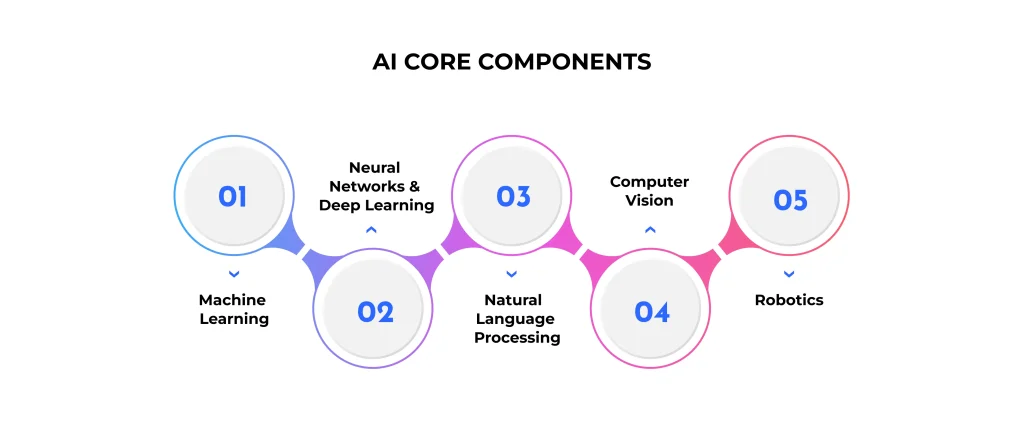
Creating artificial intelligence requires several building blocks. Successful Artificial Intelligence systems combine quality data, programming languages, frameworks, and computing power.
Data: The Fuel Behind Artificial Intelligence
Data is the foundation of every Artificial Intelligence system. Without good data, even sophisticated algorithms perform poorly.
Examples of AI datasets include:
- Images
- Videos
- Audio recordings
- Customer information
- Website analytics
- Text documents
High-quality data helps models learn accurate patterns and improve performance.
Programming Languages Used for AI Development
Python dominates AI development because of its simplicity and extensive ecosystem.
Other languages include:
| Language | Common Use |
|---|---|
| Python | Machine learning |
| R | Statistics |
| Java | Enterprise systems |
| Julia | Scientific computing |
| C++ | High-performance AI |
Python remains the preferred choice because libraries such as TensorFlow and PyTorch simplify development.
AI Frameworks and Libraries
Popular frameworks include:
- TensorFlow
- PyTorch
- Keras
- Scikit-learn
- Hugging Face
- Pandas
- NumPy
These tools eliminate much of the complexity involved in building intelligent systems.
Computing Resources
Large AI models require significant computational power.
Developers commonly use:
- GPUs
- TPUs
- Cloud platforms
- High-memory servers
Cloud services have reduced the cost of Artificial Intelligence development and made advanced computing accessible to everyone.
Step-by-Step Guide on How to Make an AI
Building AI follows a structured process. Understanding each step prevents costly mistakes and improves accuracy.
Step 1: Define the Problem
Every AI project begins with a clear objective.
Ask yourself:
- What problem am I solving?
- Who will use this AI?
- What output should it produce?
Examples include:
- Chatbots
- Fraud detection systems
- Product recommendation engines
- Medical diagnosis tools
Clear goals help determine the right datasets and algorithms.
Step 2: Collect Data
AI models learn from examples. The better your training data, the better the results.
Sources include:
- Kaggle datasets
- APIs
- Customer databases
- Web scraping
- Open-source datasets
For image recognition, thousands of labeled images may be required. Language models often require billions of words.
Step 3: Prepare and Clean Data
Raw data often contains:
- Missing values
- Duplicate entries
- Incorrect labels
- Noise
Data preprocessing involves:
- Standardization
- Feature engineering
- Data transformation
- Removing inconsistencies
Many experts believe data preparation consumes nearly 80% of an Artificial Intelligence project’s time.
Step 4: Select the Right AI Model
Different problems require different algorithms.
Classification Models
Used for:
- Email filtering
- Disease prediction
- Sentiment analysis
Regression Models
Ideal for:
- Price forecasting
- Demand prediction
- Revenue estimation
Neural Networks
Best suited for:
- Computer vision
- Voice recognition
- Text generation
Large Language Models
Excellent for:
- AI assistants
- Content generation
- Coding tools
- Search systems
Selecting the right architecture improves efficiency and accuracy. If you’re curious about modern language models, read our article on is ChatGPT generative AI to understand how generative AI systems create text and interact with users.
Step 5: Train the AI Model
Training involves feeding data into the algorithm so it learns patterns.
During training:
- Parameters are adjusted.
- Errors are minimized.
- Accuracy improves gradually.
Training time depends on:
- Dataset size
- Hardware power
- Model complexity
Small models may train in minutes, while advanced language models require weeks or months.
Step 6: Evaluate Performance
Testing ensures that the Artificial Intelligence works properly on unseen data.
Common metrics include:
- Accuracy
- Precision
- Recall
- F1 score
Poor performance indicates the need for more data or model adjustments.
Step 7: Deploy the AI
Deployment makes Artificial Intelligence available to users.
Common deployment methods include:
- Websites
- Mobile apps
- APIs
- Cloud servers
Popular cloud providers include:
- AWS
- Google Cloud
- Microsoft Azure
Deployment transforms a model into a practical application.
Step 8: Monitor and Improve
AI systems require ongoing updates because:
- User behavior changes.
- New trends emerge.
- Accuracy declines over time.
Continuous retraining ensures long-term effectiveness.
Best Tools and Technologies for Building AI
Modern tools simplify Artificial Intelligence development dramatically.
| Tool | Purpose |
| Python | Programming |
| TensorFlow | Deep learning |
| PyTorch | Neural networks |
| Pandas | Data analysis |
| NumPy | Numerical computing |
| Scikit-learn | Machine learning |
| Hugging Face | NLP models |
| OpenAI API | Generative AI |
| Google Colab | Cloud notebooks |
| LangChain | AI applications |
These tools enable developers to build sophisticated Artificial Intelligence solutions faster than ever before.
For beginners and professionals who want a simpler way to explore artificial intelligence, all-in-one AI platforms can be a practical option. One example is MakeAINow, which brings together features like AI writing, image generation, code assistance, speech-to-text, and chatbot capabilities within a single ecosystem. Instead of switching between multiple tools, users can experiment with different Artificial intelligence applications in one place, making it easier to learn, create, and streamline workflows. This approach is especially helpful for creators, developers, startups, and businesses looking to adopt Artificial intelligence solutions more efficiently while reducing the complexity often associated with building and testing new ideas.

Real-World Examples of AI Applications
Artificial intelligence powers many services we use daily.
ChatGPT
Generates text, answers questions, and assists with coding.
Netflix Recommendation Engine
Suggests content based on user behavior.
Tesla Self-Driving System
Uses computer vision and deep learning.
Google Translate
Provides multilingual translation through neural networks.
Amazon Recommendation System
Personalizes shopping experiences.
Healthcare AI
Assists doctors in disease detection and medical imaging analysis.
These examples show the enormous impact of Artificial Intelligence across industries.
Benefits of Learning How to Make an AI
Understanding how to make an AI offers advantages that go far beyond writing code. Artificial intelligence is becoming one of the most valuable skills in technology, business, and innovation. Whether you’re a student, entrepreneur, developer, or business owner, Artificial Intelligence knowledge can open new opportunities and create long-term competitive advantages.
Automation and Increased Productivity
One of the biggest benefits of Artificial intelligence is automation. Businesses use Artificial Intelligence to automate repetitive tasks that would otherwise consume valuable time and resources.
Examples include:
- Customer support chatbots
- Email filtering
- Data analysis
- Document processing
- Inventory management
Automation improves efficiency and allows employees to focus on higher-value work.
Better Decision-Making
AI systems analyze massive amounts of data and uncover patterns humans may miss. Organizations use predictive analytics to improve decisions and minimize risks.
Common applications include:
- Fraud detection
- Demand forecasting
- Healthcare diagnostics
- Financial analysis
- Marketing optimization
Data-driven decisions help companies operate more effectively.
New Career Opportunities
AI-related jobs continue to grow worldwide. Professionals with machine learning and Artificial Intelligence development skills are highly sought after.
Popular roles include:
- Machine Learning Engineer
- AI Researcher
- Data Scientist
- NLP Engineer
- Computer Vision Engineer
- AI Product Manager
As artificial intelligence expands, demand for these skills will likely continue increasing.
Innovation and Competitive Advantage
Businesses that adopt Artificial Intelligence can create better products, personalize user experiences, and reduce operational costs. Companies across healthcare, finance, retail, and education are investing heavily in AI solutions.
Once you understand how to build AI, you can also explore how to use AI effectively in everyday tasks, business operations, content creation, and productivity workflows.
Risks and Limitations of Building Artificial Intelligence

Although Artificial Intelligence offers tremendous opportunities, it also presents several challenges that developers should understand.
Data Bias
AI models learn from historical data. If that data contains bias, the Artificial Intelligence system may produce unfair or inaccurate results.
For example:
- Hiring algorithms may favor certain groups.
- Facial recognition systems may perform unevenly across demographics.
- Recommendation engines can reinforce existing preferences.
Developers should use diverse datasets and regularly audit AI performance.
High Computational Costs
Training advanced neural networks requires powerful hardware and substantial resources.
Large models often require:
- GPUs
- Cloud computing
- High memory
- Significant electricity consumption
This can make large-scale AI projects expensive.
Hallucinations and Incorrect Information
Generative Artificial intelligence systems sometimes produce false or misleading information. Large language models can generate convincing but inaccurate answers.
Human oversight remains essential for applications involving:
- Healthcare
- Finance
- Legal advice
- Scientific research
Privacy and Security Concerns
Artificial Intelligence systems frequently process sensitive information. Improper security practices can expose user data.
Organizations should prioritize:
- Data encryption
- Secure storage
- Compliance with privacy regulations
- Responsible AI governance
Lack of Explainability
Many deep learning systems function like black boxes. Understanding exactly why an AI makes certain decisions can be difficult.
Explainable Artificial Intelligence is becoming increasingly important for industries requiring transparency.
Common Mistakes Beginners Make When Learning How to Make an AI
Many newcomers become overwhelmed because they try to tackle advanced problems too quickly.
Starting With Complex Projects
Beginners often attempt to build sophisticated systems immediately. Instead, start with smaller projects like:
- Spam classifiers
- Sentiment analysis
- Image recognition
- Chatbots
Simple projects provide practical experience and build confidence.
Ignoring Data Quality
No algorithm can compensate for poor data. Bad datasets produce inaccurate predictions regardless of model complexity.
Focus on:
- Clean data
- Balanced datasets
- Correct labels
- Adequate sample sizes
Quality data is often more valuable than advanced algorithms.
Chasing New Models Constantly
Artificial Intelligence evolves rapidly, and many beginners jump from one trend to another.
Instead, master the fundamentals:
- Python
- Statistics
- Machine learning
- Data preprocessing
Strong fundamentals remain valuable despite changing technologies.
Overfitting Models
Overfitting occurs when models memorize training data rather than learning patterns.
This results in poor performance on new data.
Techniques to reduce overfitting include:
- Cross-validation
- Regularization
- More training data
- Simpler models
Neglecting Testing
Many developers focus entirely on training and forget evaluation.
Testing ensures:
- Reliability
- Accuracy
- Robustness
- Real-world usability
Proper evaluation prevents expensive mistakes.
Expert Insights for Creating Better AI Systems

Successful Artificial Intelligence practitioners share several common recommendations.
Start Small and Scale Gradually
Experts recommend beginning with manageable projects before attempting complex architectures.
Examples:
- House price prediction
- Movie recommendations
- Basic chatbots
Experience gained from simple projects creates a strong foundation.
Focus on Data More Than Models
Many professionals agree that data quality matters more than model complexity.
Better data often produces greater improvements than larger neural networks.
Spend time:
- Cleaning data
- Labeling examples
- Removing noise
- Balancing datasets
Use Pretrained Models
Modern Artificial Intelligence development doesn’t always require training from scratch.
Pretrained models offer:
- Faster deployment
- Lower costs
- Better accuracy
- Reduced hardware requirements
Popular sources include:
- Hugging Face
- OpenAI APIs
- TensorFlow Hub
Continue Learning
Artificial intelligence evolves rapidly.
Important areas to study include:
- Machine learning
- Deep learning
- Prompt engineering
- Retrieval-augmented generation
- AI agents
- Vector databases
Continuous learning helps developers remain competitive.
Traditional Programming vs Artificial Intelligence
| Feature | Traditional Programming | Artificial Intelligence |
|---|---|---|
| Rules | Written by humans | Learned from data |
| Adaptability | Limited | High |
| Data Dependency | Low | High |
| Improvement | Manual updates | Continuous learning |
| Complexity | Lower | Higher |
| Examples | Calculators | Chatbots |
| Flexibility | Fixed outputs | Dynamic outputs |
| Learning Capability | None | Self-improving |
AI excels when problems involve patterns and uncertainty, while traditional programming works best with fixed rules.
Frequently Asked Questions
Can beginners learn how to make an AI?
Yes. Modern tools, tutorials, and pre-trained models have made Artificial Intelligence development accessible to beginners.
Do I need advanced mathematics?
No. Basic statistics and algebra are sufficient to get started. More advanced concepts can be learned gradually.
Which programming language is best for AI?
Python remains the most popular language because of its simplicity and powerful libraries.
Is AI expensive to build?
Simple projects can be created using free tools and cloud platforms. Large-scale models require significant resources.
Can I build AI without coding?
Yes. No-code AI platforms allow users to create intelligent systems without programming knowledge.
Which framework should I learn first?
TensorFlow and PyTorch are excellent choices for beginners and professionals alike.
Is machine learning the same as AI?
Machine learning is a subset of artificial intelligence. Artificial Intelligence includes many broader technologies.
How long does it take to build an AI?
Simple projects can take days, while advanced systems may require months or years.
Can AI replace programmers?
Artificial Intelligence assists developers but still requires human creativity, problem-solving, and oversight.
What industries use AI?
Artificial Intelligence is used in:
- Healthcare
- Finance
- Education
- Manufacturing
- Transportation
- Marketing
- Retail
What is the future of AI?
Artificial intelligence will continue transforming industries through automation, personalization, and intelligent decision-making.
Final Verdict
Learning how to make an AI has become easier than ever thanks to open-source frameworks, cloud computing, and pre-trained models. Whether you’re building a chatbot, recommendation engine, image recognition system, or generative AI application, success depends on understanding the fundamentals, collecting quality data, selecting the right algorithms, and continuously improving your models.
Artificial intelligence is no longer limited to large tech companies. Students, startups, businesses, and independent developers now have access to tools that make Artificial Intelligence development accessible and affordable. By starting with small projects, mastering Python, and focusing on data quality, anyone can begin creating intelligent systems capable of solving real-world problems.
As AI technology continues advancing, learning how to create artificial intelligence today can provide valuable skills and opportunities for the future.