



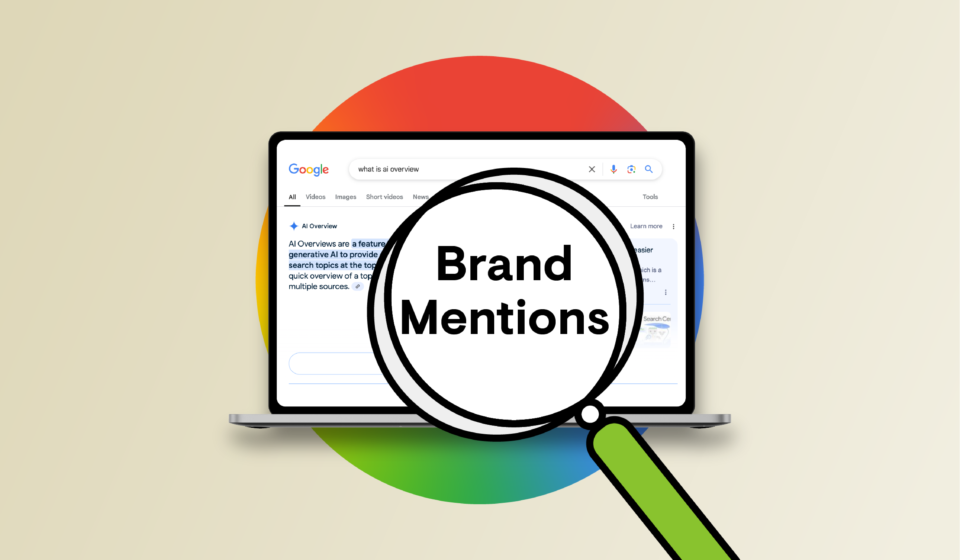

How to track brand mentions in AI search is becoming an important question for businesses that want to understand how they appear in ChatGPT, Google AI Overviews, Gemini, Claude, Perplexity, and other AI-powered search experiences. Traditional SEO tells you where your website ranks and how much organic traffic it receives. AI search adds another layer: whether AI systems mention, recommend, describe, or cite your brand when people ask relevant questions.
Table Of Content
- Quick Answer
- Key Takeaways
- What Are Brand Mentions in AI Search?
- Why Should You Track Brand Mentions in AI Search?
- Discover visibility gaps
- Understand brand perception
- Identify content opportunities
- Monitor competitors
- How to Track Brand Mentions in AI Search Step by Step
- Step 1: Create a Prompt Library
- Step 2: Test Multiple AI Platforms
- Step 3: Establish a Baseline
- Step 4: Repeat the Same Prompts
- Step 5: Analyze the Results
- What Metrics Should You Track for AI Brand Visibility?
- AI Mention Rate
- Recommendation Rate
- AI Share of Voice
- Accuracy Score
- Citation Visibility
- How to Choose AI Search Monitoring Tools
- How to Improve Brand Visibility After Tracking AI Mentions
- Strengthen topical authority
- Improve brand information
- Build credible external authority
- Comparison: Traditional SEO vs AI Brand Mention Tracking
- Real-World Examples of AI Brand Mention Tracking
- Benefits of Tracking AI Brand Mentions
- Better visibility measurement
- Stronger content planning
- Competitive intelligence
- Reputation monitoring
- Better strategic reporting
- Risks and Limitations
- Results can change
- Mention volume can mislead
- Platforms differ
- AI visibility is not revenue
- Data requires context
- Common Mistakes to Avoid
- Tracking only branded searches
- Measuring only mention count
- Changing prompts constantly
- Ignoring competitors
- Treating AI responses as facts
- Abandoning traditional SEO
- Expert Insight: Build a Continuous Monitoring Cycle
- FAQs
- 1. What is an AI brand mention?
- 2. How often should I track AI mentions?
- 3. Should I monitor competitors?
- 4. Can AI mention tracking improve SEO?
- 5. Do I need a paid monitoring tool?
- 6. Why does AI sometimes give different answers?
- Final Verdict
This matters because users can discover a business without visiting its website first. An AI-generated answer may recommend several companies, compare products, summarize an industry, or suggest a solution to a specific problem. If your competitors appear repeatedly while your brand is missing, you may be losing visibility before a traditional search click ever happens.
AI brand monitoring helps identify these opportunities. By tracking relevant prompts, recording brand mentions, comparing competitors, and reviewing the context of each response, marketers can understand how AI systems represent their business.
The process does not require blindly chasing mentions. The goal is to build a consistent measurement system that reveals where your brand appears, how it is described, why competitors are visible, and what actions can improve your overall search presence.
Quick Answer
To track brand mentions in AI search, create a fixed list of customer-focused prompts, test them regularly across relevant AI platforms, and record whether your brand is mentioned, recommended, or cited. Learning how to track brand mentions in AI search effectively also helps businesses identify visibility gaps, monitor competitors, and understand how AI platforms represent their brand.
Track these metrics:
- Brand mention rate
- Recommendation rate
- Mention prominence
- Competitor mentions
- Sentiment and accuracy
- Citation sources
- Query categories
- Visibility changes over time
For small businesses, a spreadsheet can be enough. Larger organizations can use specialized AI search monitoring platforms to automate prompt tracking and reporting.
Key Takeaways
- AI brand mentions measure visibility inside AI-generated answers.
- Track both branded and non-branded questions.
- Use consistent prompts to measure changes accurately.
- Monitor competitors as well as your own brand.
- Evaluate context, not just the number of mentions.
- Check whether AI-generated descriptions are accurate.
- Citation sources can reveal authority and content opportunities.
- AI monitoring should complement traditional SEO.
- Use the data to improve content, brand authority, and digital PR.
- Start with high-value queries instead of trying to track everything.
What Are Brand Mentions in AI Search?
An AI brand mention occurs when an AI-powered search or answer system refers to a company, product, service, or website in its response to a user’s question.
For example, someone might ask:
“What are the best AI search visibility tools for businesses?”
An AI system could generate a list of several companies. If your brand appears in that response, it has received an AI search mention.
However, simply being mentioned does not automatically mean your brand has achieved strong visibility. The context of the mention matters.
Consider three situations:
- Your brand is briefly mentioned at the end of an answer.
- Your brand appears among five recommended solutions.
- Your brand is identified as one of the strongest options with a specific reason.
All three are mentions, but they represent different levels of visibility.
This is why AI search monitoring should measure more than frequency.
A useful framework considers:
- Presence: Was the brand mentioned?
- Prominence: How visible was the mention?
- Context: Why was the brand mentioned?
- Accuracy: Was the description correct?
- Sentiment: Was the description favorable?
- Competition: Which other brands appeared?
- Sources: What information supported the response?
Traditional SEO primarily measures rankings and clicks. AI search monitoring focuses more heavily on how a brand becomes part of an AI-generated answer.
That difference is important because users increasingly use conversational interfaces to research products, compare businesses, and solve problems.
Why Should You Track Brand Mentions in AI Search?
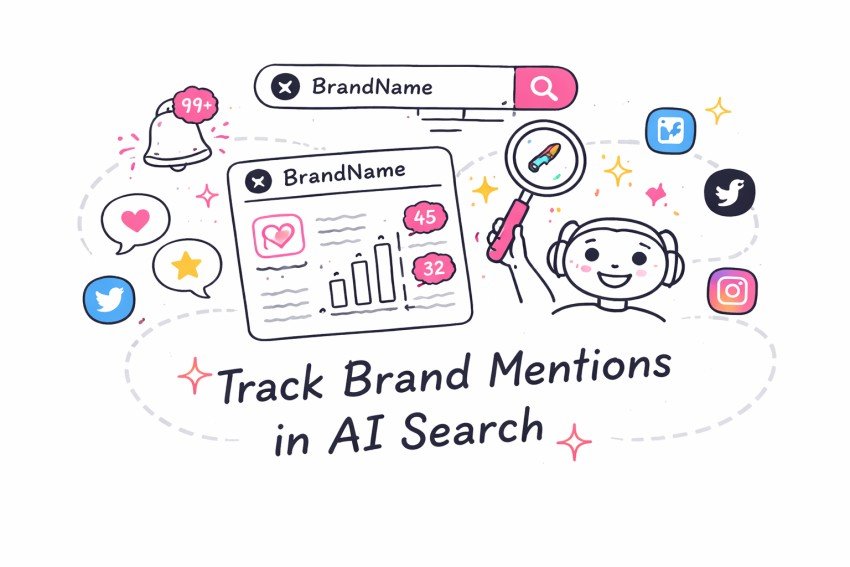
AI search visibility can influence brand discovery before a potential customer reaches a website.
Imagine a user asks:
“Which companies offer reliable AI marketing solutions?”
If competitors appear repeatedly while your company never does, traditional keyword rankings may not show the full problem. Your website could rank reasonably well for several keywords while remaining largely absent from AI-generated recommendations.
Tracking brand mentions provides another perspective.
Discover visibility gaps
You can identify questions where competitors appear but your business does not.
For example:
| Query Type | Your Brand | Competitor A |
|---|---|---|
| Category queries | 35% | 61% |
| Comparison queries | 28% | 55% |
| Problem-based queries | 18% | 47% |
| Recommendation queries | 31% | 64% |
This data highlights areas worth investigating.
Understand brand perception
AI systems may describe your company differently from how you describe yourself.
You might position your business as an enterprise solution, while AI responses repeatedly associate it with small businesses. Or the system might describe an outdated product offering.
Monitoring can reveal these inconsistencies.
Identify content opportunities
If AI answers frequently discuss topics that your website barely covers, there may be a content gap.
Instead of creating articles simply because a keyword has search volume, you can create useful resources around questions your audience is actively asking AI.
Monitor competitors
AI search can introduce competitors that are not always obvious from traditional rankings.
A company with fewer Google rankings may still appear frequently in AI recommendations because it has strong topical authority, reviews, industry coverage, or recognizable brand information.
How to Track Brand Mentions in AI Search Step by Step
A structured process makes AI monitoring much more useful than occasional manual searches.
Step 1: Create a Prompt Library
Start with questions your ideal customers are likely to ask.
Don’t track only your brand name.
Include:
- Branded queries
- Category queries
- Problem-based questions
- “Best” queries
- Comparison questions
- Alternative queries
- Product-related questions
- Industry questions
- Use-case questions
For example, instead of tracking only:
“Brand X”
also track:
- “What are the best AI search monitoring platforms?”
- “How can businesses measure AI search visibility?”
- “What tools help companies monitor AI brand mentions?”
- “What are alternatives to Brand X?”
- “Which AI visibility platform is best for SaaS companies?”
A good starting point is 30–50 high-value prompts.
Step 2: Test Multiple AI Platforms
Run your prompts across platforms relevant to your audience.
These may include:
- ChatGPT
- Google AI search experiences
- Gemini
- Claude
- Perplexity
- Microsoft Copilot
The same question can produce different results, so testing only one platform gives you an incomplete picture.
Record:
- Platform
- Date
- Exact prompt
- Brand mentioned or not
- Brand position
- Competitors
- Sentiment
- Accuracy
- Citations
- Notes
Step 3: Establish a Baseline
Before making major SEO or content changes, record your current visibility.
For example:
100 prompts tested
- Brand mentioned: 38
- Recommended: 22
- Competitor A mentioned: 57
- Competitor B mentioned: 49
- Accurate descriptions: 34
- Inaccurate descriptions: 4
This becomes your starting benchmark.
Step 4: Repeat the Same Prompts
Run your core prompt set consistently.
Monthly monitoring may be sufficient for smaller websites. More competitive brands may monitor weekly.
Do not completely replace your prompts every time.
Keeping a stable benchmark makes it easier to identify genuine changes.
Step 5: Analyze the Results
Look for patterns rather than isolated answers.
Ask:
- Where does my brand appear most frequently?
- Which questions produce no visibility?
- Which competitors dominate?
- Are my product descriptions accurate?
- Which sources are repeatedly cited?
- Are certain topics generating stronger visibility?
- Has visibility changed since the previous measurement?
These questions turn raw AI responses into useful marketing intelligence.
What Metrics Should You Track for AI Brand Visibility?
Counting mentions is only the beginning. A stronger AI monitoring dashboard should combine several metrics.
AI Mention Rate
This measures the percentage of tracked prompts where your brand appears.
Mention Rate = Brand Mentions ÷ Total Prompts × 100
If your brand appears in 40 of 100 tracked prompts, your mention rate is 40%.
Recommendation Rate
Track how often the AI actively recommends your brand rather than simply mentioning it.
This is particularly useful for commercial and “best” queries.
AI Share of Voice
Compare your brand’s visibility with competitors.
For example:
| Brand | Mentions |
| Brand A | 62 |
| Brand B | 51 |
| Brand C | 43 |
| Your Brand | 36 |
Your brand may have 36 mentions, but the more important question is whether that number is improving relative to competitors.
Accuracy Score
Check whether AI systems correctly describe:
- Your products
- Your services
- Your audience
- Your positioning
- Your key features
An inaccurate mention may require attention even if your overall mention rate is high.
Citation Visibility
Where citations are available, record which websites are referenced in AI answers.
This can help identify authoritative sources influencing how your brand or industry is represented.
How to Choose AI Search Monitoring Tools
Manual tracking is practical for a small prompt set, but it becomes difficult when you monitor hundreds of queries and several AI platforms.
Specialized tools can automate tasks such as:
- Prompt monitoring
- Brand detection
- Competitor tracking
- Historical comparisons
- Citation analysis
- Visibility reporting
- Share-of-voice measurement
When choosing a platform, focus on useful data rather than the size of the dashboard.
A good tool should help answer questions such as:
Where are we visible?
Where are competitors winning?
Which prompts are we missing?
How is AI describing our brand?
Which sources appear repeatedly?
Before investing in software, understanding why use ai search monitoring tools can help you determine whether automation is actually necessary for your business.
For a small website, a spreadsheet and regular manual checks may be sufficient. For an enterprise brand, automation can save considerable time.
How to Improve Brand Visibility After Tracking AI Mentions
Monitoring only becomes valuable when you use the findings to improve your strategy.
Suppose your tracking shows that competitors dominate questions around a particular customer problem.
Do not simply repeat the competitor’s keywords.
Instead, investigate why they are visible.
Look at:
- Content depth
- Original research
- Industry coverage
- Product documentation
- Customer reviews
- Expert commentary
- Backlinks
- Brand consistency
- Third-party references
Then create genuinely useful content that answers the underlying customer question.
Strengthen topical authority
Build clusters around important topics instead of publishing disconnected articles.
For example, an AI search visibility website might cover:
- AI search optimization
- AI brand visibility
- Generative search
- AI search monitoring
- AI Overviews
- Brand mentions
- Citation tracking
- GEO strategies
Strong topical coverage helps establish a clearer connection between your website and the subject.
Improve brand information
Make sure important information is consistent across:
- Homepage
- About page
- Product pages
- Author profiles
- Social profiles
- Business listings
- Industry directories
- Press coverage
If different sources describe your business differently, AI systems may receive conflicting information.
Build credible external authority
Your website is not the only source AI systems may encounter.
Relevant third-party mentions can include:
- Industry publications
- Expert interviews
- Reviews
- Research reports
- Partner websites
- News coverage
- Professional communities
Focus on genuine authority rather than generating large numbers of low-quality mentions.
For marketers researching what strategies improve brand visibility in ai search engines, the most sustainable approach combines useful content, expertise, consistent brand information, and credible external authority.
Comparison: Traditional SEO vs AI Brand Mention Tracking
| Factor | Traditional SEO | AI Brand Monitoring |
| Main focus | Search rankings | AI-generated visibility |
| Main metric | Keyword position | Mention rate |
| User interaction | Click | AI answer/recommendation |
| Competitor analysis | Ranking comparison | Mention comparison |
| Content measurement | Traffic and rankings | AI representation |
| Brand perception | Indirect | More direct |
| Citation analysis | Backlinks | AI-referenced sources |
| Best use | Organic search growth | Generative search visibility |
These approaches work best together.
Traditional SEO can bring users to your website, while AI visibility can influence how users discover and evaluate your brand before they click.
Real-World Examples of AI Brand Mention Tracking
Consider a SaaS company that tracks 100 prompts related to its industry.
Initially, its brand appears in only 25 responses.
Its competitors appear in:
- Competitor A: 62
- Competitor B: 54
- Competitor C: 41
The marketing team reviews the results and discovers that competitors have more comprehensive educational resources and stronger third-party industry coverage.
The company then improves its topical content, product documentation, expert content, and external authority.
After several months, it measures the same 100 prompts again.
The goal is not to guarantee a particular AI response. Instead, the company can determine whether its broader digital presence is becoming more visible.
A second example involves inaccurate information.
An AI platform repeatedly describes a company’s service as being intended for the wrong audience. The marketing team improves its product pages, FAQs, About information, and external profiles.
The same prompts are then monitored again.
This demonstrates an important point: AI monitoring can identify both visibility problems and information-quality problems.
For businesses expanding their AI search strategy, what are the best ai search monitoring tools can be an important question when comparing platforms for prompt tracking, competitor analysis, citation monitoring, and historical visibility data.
Benefits of Tracking AI Brand Mentions
AI brand monitoring offers several practical benefits.
Better visibility measurement
It shows whether your brand appears when users ask relevant questions in AI environments.
Stronger content planning
Missing prompts can reveal topics where useful content should be developed.
Competitive intelligence
You can see which competitors are repeatedly recommended and investigate their authority signals.
Reputation monitoring
Repeated inaccurate or negative descriptions can be identified earlier.
Better strategic reporting
AI visibility can be added alongside:
- Organic traffic
- Rankings
- Conversions
- Backlinks
- Brand searches
- Referral traffic
This provides a broader view of search performance.
Risks and Limitations
AI mention tracking also has limitations.
Results can change
The same prompt may produce different answers at different times.
Mention volume can mislead
More mentions do not necessarily mean better visibility. Context and sentiment matter.
Platforms differ
Different AI systems may use different models, sources, and retrieval processes.
AI visibility is not revenue
A brand can receive mentions without generating conversions.
Data requires context
A temporary change should not automatically trigger a major SEO strategy change. Look for trends across multiple measurement periods.
Common Mistakes to Avoid
Tracking only branded searches
Non-branded questions are often more valuable for measuring discovery.
Measuring only mention count
Track recommendation, prominence, sentiment, and accuracy too.
Changing prompts constantly
Use a fixed benchmark for reliable comparisons.
Ignoring competitors
Your visibility should be evaluated within the competitive landscape.
Treating AI responses as facts
AI-generated information can be incomplete or incorrect. Verify important claims.
Abandoning traditional SEO
AI search monitoring should complement technical SEO, content, links, and organic search—not replace them.
Expert Insight: Build a Continuous Monitoring Cycle
The most effective approach is simple:
Monitor → Analyze → Improve → Recheck
Start with your most important customer questions.
Measure how often your brand appears.
Identify where competitors are stronger.
Investigate the underlying reasons.
Improve your website, content, authority, and brand information.
Then test the same prompts again.
This approach is more sustainable than trying to manipulate AI systems directly.
The goal should be to create a brand that is genuinely relevant to the questions your target audience asks.
An AI system should be able to find clear, useful, consistent information about your company from a trustworthy digital ecosystem.
One useful external resource for businesses exploring AI-focused marketing and related developments is makeainow. Use it as an additional reference when researching the broader AI ecosystem.
FAQs
1. What is an AI brand mention?
It is when an AI search or answer platform refers to your brand in response to a relevant user query.
2. How often should I track AI mentions?
Monthly tracking works for many small businesses. Competitive brands may benefit from weekly monitoring.
3. Should I monitor competitors?
Yes. Competitor mentions help you understand your relative AI visibility and identify content gaps.
4. Can AI mention tracking improve SEO?
It can provide insights that support content, authority, and brand strategy, but it does not replace traditional SEO.
5. Do I need a paid monitoring tool?
Not necessarily. Small websites can start with a spreadsheet and manual testing.
6. Why does AI sometimes give different answers?
AI responses can vary because platforms use different models, sources, retrieval systems, updates, and contextual signals.
Final Verdict
Tracking brand mentions in AI search is becoming an important part of modern search visibility. Traditional rankings alone cannot show how your business appears inside AI-generated recommendations and answers.
The best approach is to create a consistent prompt library, monitor relevant AI platforms, track brand and competitor mentions, evaluate context and accuracy, and review changes over time.
Start small with your most valuable customer questions. Establish a baseline, identify visibility gaps, improve your content and authority, and repeat the measurement.
The objective is not simply to get mentioned more often. It is to become a relevant, credible, and accurately represented brand when your audience turns to AI for answers.